Barnett. Mac. Make Believe: On Telling Stories to Children. Little, Brown and Company. 2026. 112p. TR $20.00. ISBN 978-0316601122.
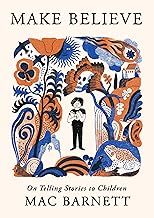
Mac Barnett’s Make Believe is a small 112-page, 5.2 x 7 book that has angered many with his statement, “Maybe 94.7% of kids’ books are crud” (p.19). He references Sturgeon’s Revelation for Science Fiction, which states 90% of Sci-Fi is crud. Barnett explains, “And that’s because kids’ books, unlike most writing, are made by people (adults) who are not members of their intended audience (kids)…There’s a gaping experimental chasm between childhood and adulthood, and the children’s author must find some way to cross. (p.19). He further states, “A good children’s book respects this autonomous zone and might even expand its borders. But too many books—sometimes inadvertently but often on purpose—make incursions into children’s imaginations in order to reinforce adult control.” (p.20).
Barnett’s opinion stretches beyond children’s literature as he states, “Lots of adult books are bad too! Most of them, even.” (p.16)
Barnett best defends his stance with his three Aunts Theory. Aunt #1 transforms into an animated caricature around children. She asks questions, but is patronizing and does not listen. Aunt #2 is strict and boring. She demands respect just for being an adult. She asks questions with an agenda of right and wrong answers. Aunt #3 is the cool aunt. Her life is filled with hobbies and interests. She asks questions, listens, and values children’s opinions. She is not afraid to say I don’t know.
The cool aunt is the one who can write excellent children’s books in Barnett’s elite 5.3%. But, how many cool aunt authors are currently in the publishing industry?
For those who are appalled by Barnett’s 94.7% crud statement and stopped reading Make Believe, or never started the book, they’ve missed his point. His statement, taken alone, sounds dismissive of children’s literature, but reading later chapters reveals Barnett’s profound respect for children’s literature and love of great children’s books.
Barnett was blunt in his assessment, but it came from a place of tough love. What he’s promoting is the creation of great children’s books and respect for the field, grounded in solid reasoning.
In a particularly moving section, Barnett reminds us that reading fiction is a contract between the author and the reader to believe. Children have limitless imaginations, so what better audience to create fictional worlds for?
All great books provoke discussion. Make Believe does just that. Barnett says what most are too polite to express about the state of publishing. Many have noted his white male privilege and position as the Library of Congress National Ambassador for Young People’s Literature. His successful career and position have given him a platform. Some are advocating that he be stripped of this position for his 94.7% statement. Of note, Barnett has never mentioned himself as part of the elite 5.3%.
So, would it have been better if he stayed quiet? What better advocate is there to demand respect for children’s literature and the creation of great children’s books than the current Library of Congress National Ambassador for Young People’s Literature? Barnett’s Make Believe asks the reader to question his opinion and theirs. Make Believe is a must-read for any adult who interacts with children. It’s a manifesto for adults who create for children. Bypass others’ opinions: check out this tiny 112-page book or listen to it (Barnett reads the audio version with great emotion), and decide for yourself.
Alva Fong, Independent
What a thoughtful and well reasoned review. Hats off, and I am off to read the book.